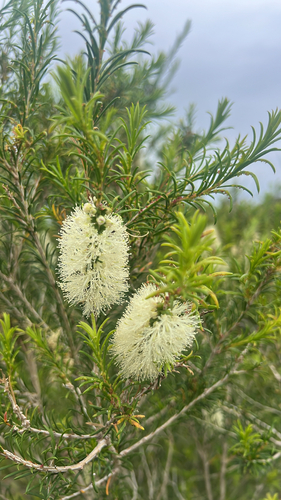
Melaleuca armillaris
Bracelet honey myrtle · also Drooping melaleuca, Giant honey myrtle, Swamp tot tree
Report an issue with this species
Melaleuca armillaris is a shrub to small tree with fine, needle-like, aromatic foliage and pendulous branches, producing fluffy white, brush-like flowers. Native to southeastern Australia, it naturally occurs on coastal cliffs and estuaries, providing habitat and nectar for birds and insects. It is a hardy, fast-growing species highly tolerant of drought, salt, smog, and coastal winds, making it suitable for challenging urban environments, though it can become invasive in some areas.
Where it grows
Trees in each city's inventory, with the share of that city's named trees this species accounts for.
- 3,5452.3%—3.8 in
- 80.00%29 yr4.5 in
Traits
- Form
- Weeping
- Foliage
- Evergreen
- Mature height
- 15–30 ft
- Canopy spread
- 15–30 ft
- Growth rate
- Fast
- Water needs
- Moderate
- Drought tolerance
- High
- Pollution tolerance
- High
- Wildlife value
- High
- Tolerates
- coastal, salt
- Blooms
- May, Jun, Jul
Trunk diameters across every city: median 3.8 in, mean 4.8 in, 90th percentile 7.5 in. Measured at breast height, as published by each inventory.
Native range
Terrestrial ecoregions where this species is native. Trees in the dataset mostly stand well outside it.
Temperate Broadleaf & Mixed Forests
- Eastern Australian temperate forests
- Southeast Australia temperate forests
Temperate Grasslands, Savannas & Shrublands
- Southeast Australia temperate savanna
Other Melaleuca in the catalogue
15 of the top 2,000 species are in this genus.


