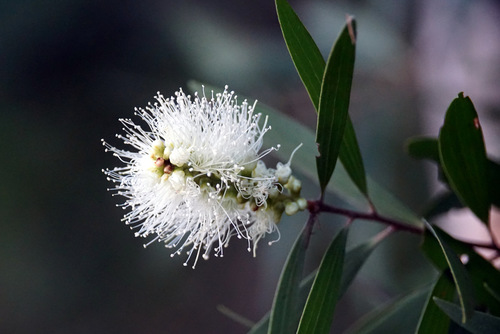
Melaleuca quinquenervia
Broad-leaved paperbark · also Paper bark tea tree, Niaouli, Punk tree
Report an issue with this species
Melaleuca quinquenervia is a small to medium-sized spreading tree known for its distinctive thick, papery bark and bottlebrush-like cream or white flowers. It thrives in wet, silty soils found in swamps, floodplains, and near coastal estuaries, making it a hardy and versatile choice for urban landscapes, providing shade and aesthetic appeal.
Where it grows
Trees in each city's inventory, with the share of that city's named trees this species accounts for.
- 1,3660.29%30 yr9.0 in
- 1,1480.86%24 yr7.0 in
- 270.02%—5.6 in
Traits
- Form
- Spreading
- Foliage
- Evergreen
- Mature height
- 20–70 ft
- Canopy spread
- 15–25 ft
- Growth rate
- Moderate
- Soil
- Silty
- Water needs
- Low
- Drought tolerance
- High
- Wildlife value
- Moderate
- Tolerates
- salt
- Blooms
- Jun, Jul, Aug, Sep, Oct, Nov
Trunk diameters across every city: median 7.5 in, mean 11 in, 90th percentile 21 in. Measured at breast height, as published by each inventory.
Native range
Terrestrial ecoregions where this species is native. Trees in the dataset mostly stand well outside it.
Tropical & Subtropical Moist Broadleaf Forests
- New Caledonia rain forests
- Northern New Guinea lowland rain and freshwater swamp forests
- Queensland tropical rain forests
- Southern New Guinea freshwater swamp forests
Tropical & Subtropical Dry Broadleaf Forests
- New Caledonia dry forests
Temperate Broadleaf & Mixed Forests
- Southeast Australia temperate forests
Mangroves
- New Guinea mangroves
Other Melaleuca in the catalogue
15 of the top 2,000 species are in this genus.


