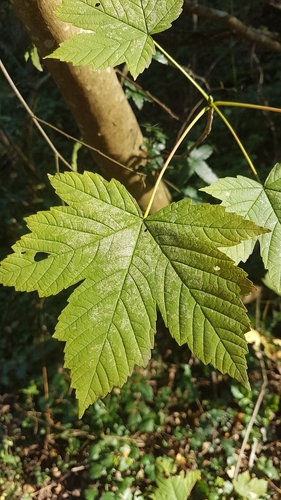
Acer pseudoplatanus
Sycamore maple · also Sycamore, Scottish maple, Mock plane tree
Report an issue with this species
A large deciduous tree native to Central Europe and Western Asia, the sycamore maple forms a broad, rounded canopy. It tolerates wind, coastal exposure, salt spray, and smog, making it suitable for urban environments, though it can be invasive in introduced areas and is susceptible to leaf spot. Its greenish-yellow flowers provide nectar for insects.
Where it grows
Trees in each city's inventory, with the share of that city's named trees this species accounts for.
- 51,5134.5%—4.0 in
- 12,8022.9%47 yr13 in
- 8,4283.0%42 yr16 in
- 6,9363.0%—14 in
- 2,8880.40%—13 in
- 2,1671.2%—16 in
- 4700.96%52 yr2.6 in
- 2440.03%—19 in
- 2400.68%—17 in
- 2240.19%33 yr15 in
- 1300.18%—9.3 in
- 1280.04%—3.9 in
- 1080.69%—15 in
- 950.03%—3.0 in
- 440.02%—3.3 in
- 270.04%51 yr9.8 in
- 200.01%7.0 yr2.0 in
- 190.03%—9.4 in
- 170.01%20 yr11 in
- 90.02%—16 in
- 80.02%—2.4 in
- 80.07%—3.9 in
- 80.00%——
- 40.00%—5.5 in
- 30.00%—1.9 in
- 10.00%—14 in
Traits
- Form
- Broadleaf
- Foliage
- Deciduous
- Mature height
- 50–115 ft
- Canopy spread
- 40–60 ft
- Wildlife value
- High
- Blooms
- Mar, Apr, May
Trunk diameters across every city: median 6.3 in, mean 8.7 in, 90th percentile 19 in. Measured at breast height, as published by each inventory.
Native range
Terrestrial ecoregions where this species is native. Trees in the dataset mostly stand well outside it.
Temperate Broadleaf & Mixed Forests
- Balkan mixed forests
- Caucasus mixed forests
- Central European mixed forests
Mediterranean Forests, Woodlands & Scrub
- Northeast Spain and Southern France Mediterranean forests
Other Acer in the catalogue
50 of the top 2,000 species are in this genus.


