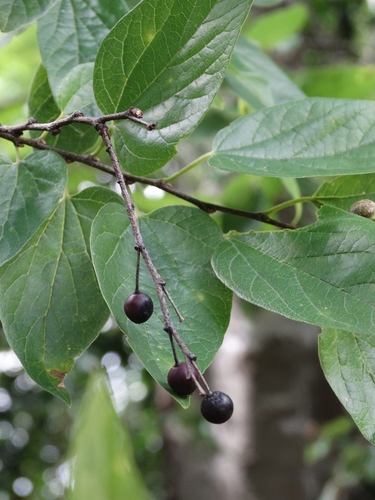
Celtis laevigata
Sugarberry · also Southern hackberry, Sugar hackberry, Hackberry
Report an issue with this species
Celtis laevigata is a medium-sized deciduous tree with thin, slightly drooping branches and smooth, pale bark that develops corky protrusions with age. It is typically found in bottomland areas along streams and floodplains. Its orange-red to black drupes attract birds and small mammals, making it valuable for wildlife, and it is notably resistant to urban pollution, poor soils, drought, and root disturbance.
Where it grows
Trees in each city's inventory, with the share of that city's named trees this species accounts for.
- 5800.29%8.5 yr4.0 in
- 770.03%—9.0 in
- 20.00%—13 in
- 20.00%—9.8 in
- 20.00%—34 in
- 10.00%—15 in
Traits
- Foliage
- Deciduous
- Mature height
- 50–60 ft
- Canopy spread
- 40–50 ft
- Growth rate
- Moderate
- Drought tolerance
- High
- Wildlife value
- High
- Blooms
- Mar, Apr, May
Trunk diameters across every city: median 4.1 in, mean 5.3 in, 90th percentile 9.6 in. Measured at breast height, as published by each inventory.
Native range
Terrestrial ecoregions where this species is native. Trees in the dataset mostly stand well outside it.
Tropical & Subtropical Moist Broadleaf Forests
- Central American Atlantic moist forests
- Leeward Islands moist forests
Tropical & Subtropical Grasslands, Savannas & Shrublands
- Western Gulf coastal grasslands
Tropical & Subtropical Dry Broadleaf Forests
- Central American dry forests
Other Celtis in the catalogue
11 of the top 2,000 species are in this genus.


