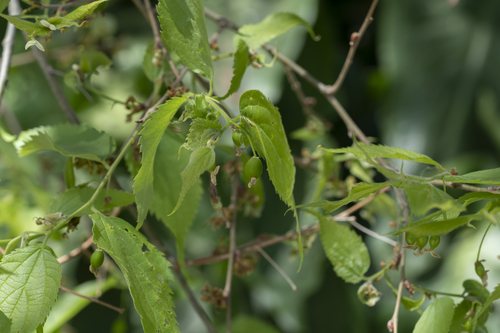
Celtis australis
European nettle tree · also European hackberry, Mediterranean hackberry, Lote tree
Report an issue with this species
This deciduous tree features a broad, rounded canopy that provides ample shade, with lance-shaped, serrated leaves that turn yellow in the fall. Its smooth gray bark becomes rougher with age. Small, dark berries appear in late summer, attracting birds and wildlife, making it well-suited for urban environments due to its resilience and adaptability.
Where it grows
Trees in each city's inventory, with the share of that city's named trees this species accounts for.
- 5,0562.2%—11 in
- 1,4180.13%—1.0 in
- 1760.06%18 yr5.9 in
- 1652.0%——
- 1270.03%3.8 yr2.6 in
- 720.02%—9.1 in
- 400.01%—8.0 in
- 210.00%35 yr7.5 in
- 80.01%—3.0 in
- 30.00%—5.6 in
- 20.00%—27 in
- 10.00%——
Traits
- Form
- Broadleaf
- Foliage
- Deciduous
- Mature height
- 40–70 ft
- Canopy spread
- 40–50 ft
- Growth rate
- Fast
- Wildlife value
- Moderate
- Blooms
- Mar, Apr, May
Trunk diameters across every city: median 8.8 in, mean 9.1 in, 90th percentile 17 in. Measured at breast height, as published by each inventory.
Native range
Terrestrial ecoregions where this species is native. Trees in the dataset mostly stand well outside it.
Mediterranean Forests, Woodlands & Scrub
- Aegean and Western Turkey sclerophyllous and mixed forests
- Cyprus Mediterranean forests
- Northeast Spain and Southern France Mediterranean forests
Temperate Broadleaf & Mixed Forests
- Balkan mixed forests
Other Celtis in the catalogue
11 of the top 2,000 species are in this genus.


