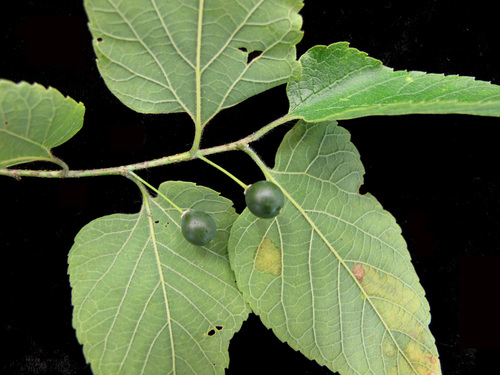
Celtis occidentalis
Common hackberry · also American hackberry, Northern hackberry, Nettletree
Report an issue with this species
This large deciduous tree is known for its rugged, cork-like bark and asymmetrical, coarse-textured leaves, producing small, bird-attracting fruits in autumn. Highly adaptable to various soil types and urban conditions, it offers a sturdy, shade-providing canopy due to its deep root system. It is a moderately long-lived hardwood common in Eastern North America.
Where it grows
Trees in each city's inventory, with the share of that city's named trees this species accounts for.
- 14,1492.1%—3.1 in
- 10,6973.2%11 yr5.9 in
- 10,6403.5%—9.0 in
- 10,3093.2%9.4 yr3.5 in
- 5,4663.5%7.9 yr2.8 in
- 4,9881.8%—2.4 in
- 3,9352.0%6.0 yr3.0 in
- 3,5940.50%—7.0 in
- 2,3160.76%—2.4 in
- 1,9012.3%—2.4 in
- 1,7813.8%—2.0 in
- 1,5842.1%3.8 yr1.6 in
- 1,4912.0%3.8 yr3.1 in
- 1,4523.3%—2.4 in
- 9990.85%4.2 yr2.0 in
- 5001.1%8.8 yr2.8 in
- 4673.9%8.8 yr7.0 in
- 3640.20%—3.0 in
- 1470.06%—12 in
- 1181.4%——
- 1090.94%10 yr3.9 in
- 1020.04%6.8 yr7.9 in
- 1000.02%6.1 yr2.4 in
- 660.28%—6.7 in
- 470.01%—2.8 in
- 270.08%—2.0 in
- 250.01%35 yr7.5 in
- 240.01%9.8 yr5.8 in
- 190.01%—3.5 in
- 150.01%—8.0 in
- 100.06%5.8 yr2.0 in
- 20.00%—2.0 in
Traits
- Foliage
- Deciduous
- Mature height
- 45–80 ft
- Canopy spread
- 40–50 ft
- Growth rate
- Fast
- Wildlife value
- High
- Blooms
- Mar, Apr, May
Trunk diameters across every city: median 3.1 in, mean 5.7 in, 90th percentile 13 in. Measured at breast height, as published by each inventory.
Other Celtis in the catalogue
11 of the top 2,000 species are in this genus.


