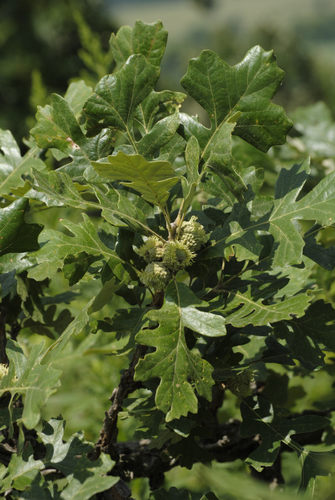
Quercus macrocarpa
Bur oak · also Burr oak, Mossycup oak, Mossycup white oak
Report an issue with this species
This large tree features a broad, rounded canopy that provides ample shade, and deeply lobed leaves that turn a golden brown in the fall. It is known for its thick, corky bark and produces large, fringed acorns that are an important food source for wildlife. The Bur Oak is highly adaptable to various soil types and can tolerate drought, making it a resilient and long-lived choice for urban environments.
Where it grows
Trees in each city's inventory, with the share of that city's named trees this species accounts for.
- 17,9153.7%8.4 yr2.8 in
- 16,2255.3%—13 in
- 10,7362.0%—2.8 in
- 7,9181.1%—3.1 in
- 6,1272.0%—3.0 in
- 4,3491.3%—5.9 in
- 3,3841.0%5.4 yr2.0 in
- 2,8641.1%—4.3 in
- 1,5260.97%7.8 yr2.8 in
- 1,1402.4%—2.0 in
- 9780.50%8.8 yr4.6 in
- 8491.9%12 yr2.8 in
- 7070.85%—10 in
- 6490.87%3.8 yr1.6 in
- 5770.08%—6.0 in
- 3510.79%—2.4 in
- 3440.46%3.8 yr2.4 in
- 2400.21%—2.0 in
- 1931.7%5.4 yr2.0 in
- 1160.49%—4.9 in
- 1140.06%—3.0 in
- 660.56%14 yr7.0 in
- 190.12%3.5 yr2.0 in
- 80.00%—5.5 in
- 70.00%—7.5 in
- 50.01%—2.4 in
- 30.00%—2.0 in
- 10.00%—3.4 in
Traits
- Form
- Broadleaf
- Foliage
- Deciduous
- Mature height
- 50–80 ft
- Canopy spread
- 30 ft
- Water needs
- Moderate
- Drought tolerance
- Moderate
- Pollution tolerance
- Moderate
- Wildlife value
- High
- Blooms
- Mar, Apr, May
Trunk diameters across every city: median 3.5 in, mean 7.0 in, 90th percentile 17 in. Measured at breast height, as published by each inventory.
Native range
Terrestrial ecoregions where this species is native. Trees in the dataset mostly stand well outside it.
Temperate Grasslands, Savannas & Shrublands
- Central US forest-grasslands transition
- Central Tallgrass prairie
- Central-Southern US mixed grasslands
- Montana Valley and Foothill grasslands
- Nebraska Sand Hills mixed grasslands
- Northern Tallgrass prairie
Temperate Broadleaf & Mixed Forests
- New England-Acadian forests
- Western Great Lakes forests
Temperate Conifer Forests
- Alberta-British Columbia foothills forests
Other Quercus in the catalogue
74 of the top 2,000 species are in this genus.


