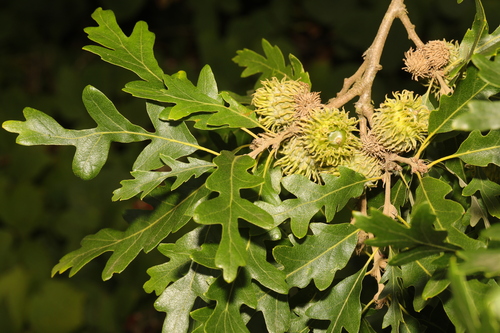
Quercus cerris
Turkey oak · also Austrian oak, Moss-cupped oak, Hairy oak
Report an issue with this species
Quercus cerris, also known as Turkey oak, is a deciduous oak native to south-eastern Europe and Asia Minor. It is characterized by shoot buds surrounded by soft bristles and bristle-tipped leaf lobes. Its acorns mature over 18 months, and it provides value to urban wildlife such as birds and mammals, while exhibiting resistance to certain diseases.
Where it grows
Trees in each city's inventory, with the share of that city's named trees this species accounts for.
- 3,7820.33%—5.0 in
- 1,2300.43%32 yr9.8 in
- 7240.32%—4.1 in
- 6360.15%4.8 yr2.6 in
- 2410.49%14 yr2.8 in
- 130.01%—3.8 in
- 100.00%—12 in
- 70.01%—44 in
- 40.03%—4.3 in
- 30.00%—13 in
- 10.00%—1.2 in
Traits
- Foliage
- Deciduous
- Mature height
- 30–50 ft
- Canopy spread
- 30–50 ft
- Water needs
- Moderate
- Wildlife value
- Moderate
- Blooms
- Mar, Apr, May
Trunk diameters across every city: median 4.5 in, mean 5.9 in, 90th percentile 11 in. Measured at breast height, as published by each inventory.
Native range
Terrestrial ecoregions where this species is native. Trees in the dataset mostly stand well outside it.
Temperate Broadleaf & Mixed Forests
- Balkan mixed forests
- Caucasus mixed forests
- Eastern Anatolian deciduous forests
- Western European broadleaf forests
Mediterranean Forests, Woodlands & Scrub
- Aegean and Western Turkey sclerophyllous and mixed forests
- Northeast Spain and Southern France Mediterranean forests
Other Quercus in the catalogue
74 of the top 2,000 species are in this genus.


