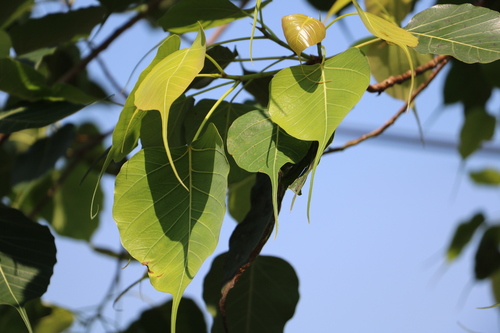
Ficus religiosa
Peepul tree · also Bodhi tree, Sacred fig, Ficus religiosa
Report an issue with this species
Ficus religiosa, also known as the sacred fig or Bodhi tree, is native to the Indian subcontinent and Indochina. This large tree is briefly deciduous and holds significant religious importance in Hinduism and Buddhism. While often planted for its cultural value, it has been assessed as a high-risk invasive species in some areas like Hawaii.
Where it grows
Trees in each city's inventory, with the share of that city's named trees this species accounts for.
- 1,5410.95%—14 in
- 30.00%—18 in
No city in this list records planting dates for this species, so age is blank throughout.
Traits
- Foliage
- Deciduous
- Mature height
- 50 ft
- Canopy spread
- 60–75 ft
- Water needs
- Moderate
Trunk diameters across every city: median 14 in, mean 14 in, 90th percentile 22 in. Measured at breast height, as published by each inventory.
Native range
Terrestrial ecoregions where this species is native. Trees in the dataset mostly stand well outside it.
Tropical & Subtropical Dry Broadleaf Forests
- Central Indochina dry forests
- Chhota-Nagpur dry deciduous forests
- East Deccan dry-evergreen forests
- Irrawaddy dry forests
- Khathiar-Gir dry deciduous forests
- Narmada Valley dry deciduous forests
- Southeast Indochina dry evergreen forests
Tropical & Subtropical Moist Broadleaf Forests
- East Deccan moist deciduous forests
- Myanmar coastal rain forests
Tropical & Subtropical Coniferous Forests
- Northeast India-Myanmar pine forests
Other Ficus in the catalogue
24 of the top 2,000 species are in this genus.


