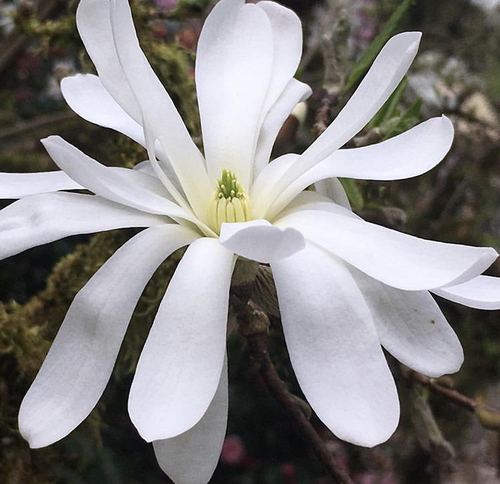
Magnolia stellata
Star magnolia · also Tree star magnolia, Rubra star magnolia
Report an issue with this species
Magnolia stellata, also known as Star Magnolia, is a slow-growing deciduous shrub or small tree native to Japan. It features showy white or pink flowers in early spring, often before its leaves emerge, and exhibits a multi-trunked or low-branching growth habit with grayish-white bark. This species prefers full sun to part shade and moderate moisture, thriving in nutrient-rich, moisture-retentive soils, but can be susceptible to frost damage.
Where it grows
Trees in each city's inventory, with the share of that city's named trees this species accounts for.
- 1110.05%—9.8 in
- 660.06%—7.0 in
- 430.01%—3.0 in
- 390.02%—5.0 in
- 380.02%11 yr5.0 in
- 360.02%—3.1 in
- 290.01%2.2 yr2.0 in
- 190.01%18 yr5.9 in
- 150.02%—4.7 in
- 120.00%—8.0 in
- 80.00%36 yr1.5 in
- 60.00%—1.8 in
- 50.01%—2.4 in
- 40.03%—3.1 in
- 30.01%—2.0 in
- 20.00%—4.0 in
- 20.02%—2.0 in
- 10.00%——
Traits
- Form
- Ornamental
- Foliage
- Deciduous
- Mature height
- 10–40 ft
- Canopy spread
- 12–15 ft
- Growth rate
- Slow
- Sun
- Full sun, Part shade
- Soil
- Nutrient-rich, Moisture-retentive
- Water needs
- Moderate
- Drought tolerance
- Moderate
- Blooms
- Feb, Mar, Apr
Trunk diameters across every city: median 3.5 in, mean 5.5 in, 90th percentile 10 in. Measured at breast height, as published by each inventory.
Native range
Terrestrial ecoregions where this species is native. Trees in the dataset mostly stand well outside it.
Temperate Broadleaf & Mixed Forests
- Nihonkai montane deciduous forests
- Taiheiyo montane deciduous forests
Temperate Conifer Forests
- Honshu alpine conifer forests
Other Magnolia in the catalogue
32 of the top 2,000 species are in this genus.


