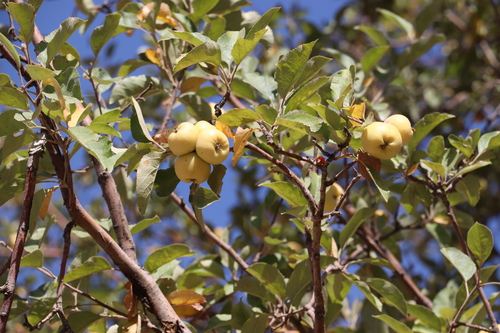
Malus sieversii
Malus sieversii
Report an issue with this species
Malus sieversii, a wild apple native to Central Asia, is considered the primary ancestor of the domesticated apple. It can grow as a shrub or tree and prefers warm, damp habitats in forest, woodland, and shrubland environments. It is valued for its fruit (food source), genetic material, and for attracting wildlife.
Where it grows
Trees in each city's inventory, with the share of that city's named trees this species accounts for.
- 170.01%14 yr13 in
- 10.00%——
Traits
- Foliage
- Deciduous
- Mature height
- 15–50 ft
- Canopy spread
- 15–25 ft
- Growth rate
- Moderate
- Water needs
- Moderate
- Wildlife value
- High
Trunk diameters across every city: median 13 in, mean 13 in, 90th percentile 18 in. Measured at breast height, as published by each inventory.
Native range
Terrestrial ecoregions where this species is native. Trees in the dataset mostly stand well outside it.
Temperate Conifer Forests
- Western Himalayan subalpine conifer forests
- Altai montane forest and forest steppe
Temperate Grasslands, Savannas & Shrublands
- Alai-Western Tian Shan steppe
- Kazakh forest steppe
Temperate Broadleaf & Mixed Forests
- Western Himalayan broadleaf forests
Deserts & Xeric Shrublands
- Registan-North Pakistan sandy desert
Other Malus in the catalogue
37 of the top 2,000 species are in this genus.


