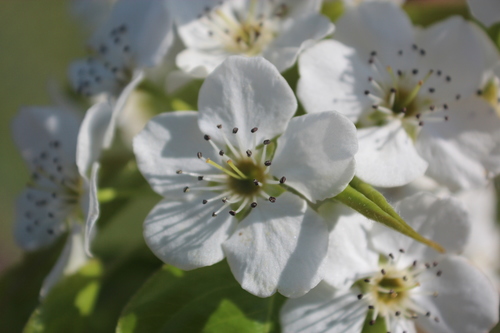
Pyrus ussuriensis
Ussurian pear · also Harbin pear, Manchurian pear, Chinese pear
Report an issue with this species
Pyrus ussuriensis, also known as Ussurian pear, is a deciduous tree that grows to about 15 meters tall. It blooms with pinkish-white flowers in spring and has dark green leaves that turn red and gold in autumn. The tree prefers well-drained loam and is considered the hardiest of all pears, providing food for many bird and mammal species.
Where it grows
Trees in each city's inventory, with the share of that city's named trees this species accounts for.
- 1,2380.24%—2.0 in
- 2310.07%5.9 yr2.0 in
- 2090.04%6.4 yr2.8 in
- 1160.04%—3.9 in
- 780.10%—9.3 in
- 370.03%23 yr22 in
- 270.02%—3.8 in
- 250.06%—14 in
- 200.01%4.6 yr2.0 in
- 50.01%—5.1 in
- 40.01%—5.9 in
- 20.00%——
- 10.00%—1.2 in
- 10.00%——
Traits
- Foliage
- Deciduous
- Mature height
- 49.2 ft
- Soil
- Well-drained, Loamy
- Wildlife value
- High
- Blooms
- Mar, Apr, May
Trunk diameters across every city: median 2.4 in, mean 3.7 in, 90th percentile 7.5 in. Measured at breast height, as published by each inventory.
Native range
Terrestrial ecoregions where this species is native. Trees in the dataset mostly stand well outside it.
Temperate Broadleaf & Mixed Forests
- Central China Loess Plateau mixed forests
- Central Korean deciduous forests
- Northeast China Plain deciduous forests
- Southern Korea evergreen forests
Other Pyrus in the catalogue
13 of the top 2,000 species are in this genus.


