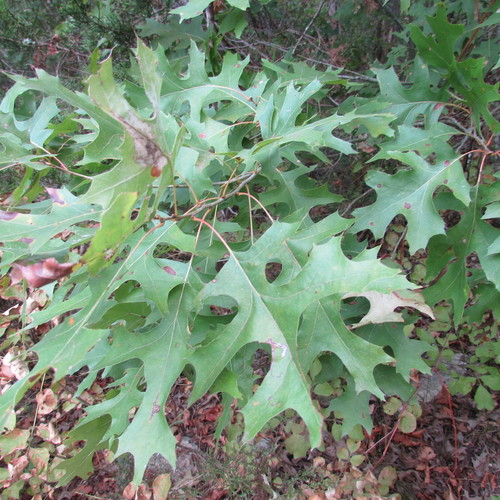
Quercus buckleyi
Texas red oak · also Buckley's oak, Spanish oak, Texas oak
Report an issue with this species
Quercus buckleyi, commonly known as Texas red oak, is a deciduous tree native to the southern Great Plains (Oklahoma and Texas). It is prized for its ornamental value, with deeply lobed leaves turning vivid red and orange in autumn. This species is well-suited for urban plantings due to its modest size, cold hardiness, and adaptation to alkaline soils.
Where it grows
Trees in each city's inventory, with the share of that city's named trees this species accounts for.
- 3990.13%—3.0 in
- 50.02%—1.0 in
No city in this list records planting dates for this species, so age is blank throughout.
Traits
- Form
- Multi-trunk
- Foliage
- Deciduous
- Mature height
- 30–50 ft
- Canopy spread
- 30–50 ft
- Soil
- Alkaline-tolerant
- Water needs
- Moderate
- Wildlife value
- High
- Blooms
- Mar, Apr, May
Trunk diameters across every city: median 3.0 in, mean 4.1 in, 90th percentile 9.0 in. Measured at breast height, as published by each inventory.
Native range
Terrestrial ecoregions where this species is native. Trees in the dataset mostly stand well outside it.
Temperate Broadleaf & Mixed Forests
- East Central Texas forests
Other Quercus in the catalogue
74 of the top 2,000 species are in this genus.


