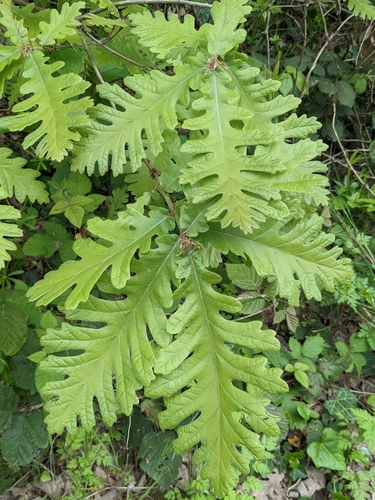
Quercus frainetto
Hungarian oak · also Italian oak
Report an issue with this species
Hungarian oak (Quercus frainetto) is a majestic tree with a broad canopy, deeply lobed leaves, and gnarled branches, providing excellent shade. It thrives in well-drained soils and exhibits high tolerance to drought and pollution, making it a robust choice for urban environments and large gardens. Its extensive root system contributes to its hardiness and overall beauty.
Where it grows
Trees in each city's inventory, with the share of that city's named trees this species accounts for.
- 4800.11%15 yr6.0 in
- 2890.16%—3.0 in
- 2530.52%8.8 yr—
- 1640.01%—3.8 in
- 1180.05%—4.5 in
- 960.03%31 yr9.8 in
- 560.36%5.7 yr12 in
- 270.01%—3.0 in
- 50.01%——
- 30.01%—2.8 in
- 10.00%—43 in
Traits
- Foliage
- Deciduous
- Mature height
- 50–60 ft
- Canopy spread
- 70 ft
- Growth rate
- Fast
- Soil
- Well-drained
- Water needs
- Moderate
- Drought tolerance
- High
- Pollution tolerance
- High
- Wildlife value
- Moderate
- Blooms
- Mar, Apr, May
Trunk diameters across every city: median 3.9 in, mean 7.2 in, 90th percentile 17 in. Measured at breast height, as published by each inventory.
Native range
Terrestrial ecoregions where this species is native. Trees in the dataset mostly stand well outside it.
Temperate Broadleaf & Mixed Forests
- Balkan mixed forests
Mediterranean Forests, Woodlands & Scrub
- Aegean and Western Turkey sclerophyllous and mixed forests
Other Quercus in the catalogue
74 of the top 2,000 species are in this genus.


