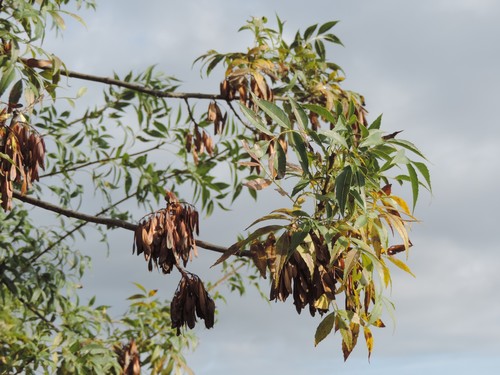
Fraxinus angustifolia
Narrow-leaved ash · also Raywood ash, Desert ash
Report an issue with this species
This deciduous tree, native to central-southern Europe, Northwest Africa, and Southwest Asia, features elegant, slender branches and a dense, rounded canopy. Its wind-pollinated blooms are followed by papery, winged fruits. It is a fast-growing species that requires full sunlight and has moderate water needs, though it is considered highly invasive in southern Australia.
Where it grows
Trees in each city's inventory, with the share of that city's named trees this species accounts for.
- 1,7340.15%—4.3 in
- 1,0990.39%29 yr9.8 in
- 1,0890.71%—5.6 in
- 1,0170.44%—5.6 in
- 8430.46%—16 in
- 2090.05%13 yr4.4 in
- 1100.08%—5.0 in
- 660.19%—6.3 in
- 640.41%21 yr7.7 in
- 580.01%30 yr7.5 in
- 550.11%21 yr2.4 in
- 290.11%—6.0 in
- 170.01%23 yr42 in
- 60.00%35 yr6.9 in
- 20.00%—15 in
- 10.00%—7.9 in
Traits
- Form
- Broadleaf
- Foliage
- Deciduous
- Mature height
- 40–50 ft
- Canopy spread
- 20–30 ft
- Growth rate
- Fast
- Sun
- Full sun
- Water needs
- Moderate
- Blooms
- Mar, Apr, May, Jun, Jul, Aug, Sep, Oct, Nov
Trunk diameters across every city: median 5.6 in, mean 7.9 in, 90th percentile 16 in. Measured at breast height, as published by each inventory.
Native range
Terrestrial ecoregions where this species is native. Trees in the dataset mostly stand well outside it.
Temperate Broadleaf & Mixed Forests
- Balkan mixed forests
- Caucasus mixed forests
- Central European mixed forests
- Western European broadleaf forests
Temperate Conifer Forests
- Elburz Range forest steppe
Mediterranean Forests, Woodlands & Scrub
- Northeast Spain and Southern France Mediterranean forests
Other Fraxinus in the catalogue
20 of the top 2,000 species are in this genus.


