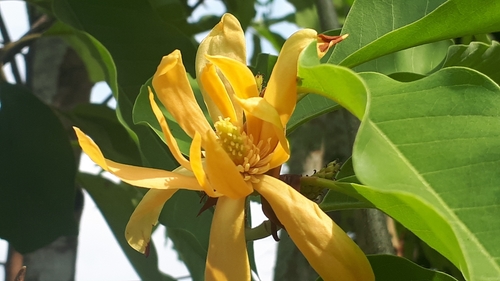
Magnolia champaca
Champak · also Golden champaca, Joy perfume tree, Yellow champaca
Report an issue with this species
Magnolia champaca is a large evergreen tree known for its highly fragrant, yellowish-orange flowers that bloom from mid-winter to early summer. It has glossy green foliage, provides a lush canopy, and is valued for its ornamental appeal and timber. This species is popular in tropical to subtropical gardens, attracting hummingbirds and butterflies, but is sensitive to frost.
Where it grows
Trees in each city's inventory, with the share of that city's named trees this species accounts for.
- 1020.08%3.2 yr3.0 in
- 620.04%—5.9 in
Traits
- Foliage
- Evergreen
- Mature height
- 10–25 ft
- Canopy spread
- 10–25 ft
- Growth rate
- Fast
- Water needs
- Moderate
- Wildlife value
- High
- Blooms
- Jan, Feb, Mar, Apr, May, Jun, Jul, Aug, Dec
Trunk diameters across every city: median 3.0 in, mean 5.1 in, 90th percentile 9.9 in. Measured at breast height, as published by each inventory.
Native range
Terrestrial ecoregions where this species is native. Trees in the dataset mostly stand well outside it.
Tropical & Subtropical Moist Broadleaf Forests
- Borneo lowland rain forests
- Borneo montane rain forests
- Borneo peat swamp forests
- Brahmaputra Valley semi-evergreen forests
- Myanmar coastal rain forests
- Northern Thailand-Laos moist deciduous forests
- Northern Vietnam lowland rain forests
- South China-Vietnam subtropical evergreen forests
- Tenasserim-South Thailand semi-evergreen rain forests
Tropical & Subtropical Dry Broadleaf Forests
- Lesser Sundas deciduous forests
Other Magnolia in the catalogue
32 of the top 2,000 species are in this genus.


