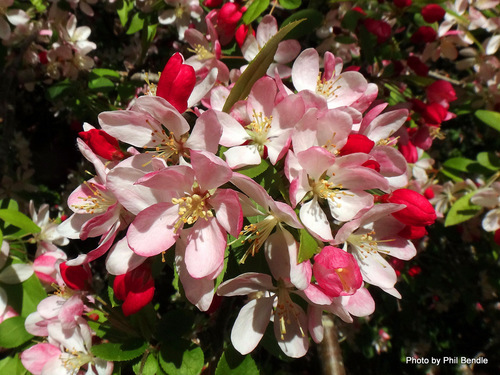
Malus x floribunda
Report an issueBy recorded trees in the inventory.
Japanese flowering crabapple · also Japanese crab, Purple chokeberry, Showy crabapple
Malus × floribunda, commonly known as Japanese flowering crabapple, is a hybrid species celebrated for its showy flowers that bloom in spring. It produces small, edible fruits that often persist into winter, attracting birds and bees. This medium-sized tree is native to East Asia, particularly Korea, and is known for its moderate water needs.
Species colors
- Foliage
- #545a20
Traits
- Form & size
- Mature height25 ftCanopy spread25 ft
- Deciduous foliage
- Blooms
- Mar, Apr, May
- Fast growth rate
- Moderate water needs
- Moderate wildlife value
Size sketches use the middle of each recorded range (or the available bound), beside a 6 ft person. Missing dimensions are illustrative.
Trunk diameters across every city: median 4.4 in, mean 5.6 in, 90th percentile 11 in. Measured at breast height, as published by each inventory.
Where it grows
Cities that list the tree in their inventory, and what % of their named trees it represents.
- 1,5910.87%—8.0 in
- 1,2510.16%—2.6 in
- 4010.15%—3.0 in
- 3700.07%——
- 3460.12%37 yr5.9 in
- 2560.20%42 yr—
- 2020.37%—3.5 in
- 2000.19%24 yr3.9 in
- 1690.10%36 yr—
- 1300.06%—6.3 in
- 1270.37%—5.1 in
- 1270.23%22 yr—
- 1210.03%37 yr6.0 in
- 1200.07%—5.0 in
- 1160.13%—4.3 in
- 1050.15%—3.0 in
- 960.04%26 yr5.0 in
- 850.10%27 yr9.4 in
- 760.16%66 yr4.4 in
- 660.03%25 yr5.1 in
- 490.04%—3.8 in
- 470.03%37 yr7.9 in
- 460.06%—3.9 in
- 440.04%37 yr—
- 390.25%—5.3 in
- 380.03%——
- 360.03%——
- 330.01%7.4 yr3.0 in
- 290.01%22 yr4.5 in
- 230.08%——
- 180.02%37 yr—
- 170.03%—3.1 in
- 160.08%——
- 160.01%18 yr5.5 in
- 150.03%—7.3 in
- 130.03%—5.9 in
- 130.01%4.6 yr2.0 in
- 90.04%6.9 yr—
- 80.02%—11 in
- 70.00%—19 in
- 60.01%—13 in
- 60.04%—1.9 in
- 60.01%—9.0 in
- 40.01%—6.1 in
- 30.00%——
- 20.00%—3.5 in
- 10.00%—10 in
- 10.00%——
- 10.00%—3.0 in
- 10.00%—14 in
Native range
Ecoregions where the species is native.
Temperate Broadleaf & Mixed Forests
- Southern Korea evergreen forests
Other Malus in the catalogue
43 of the top 2,000 species are in this genus.


