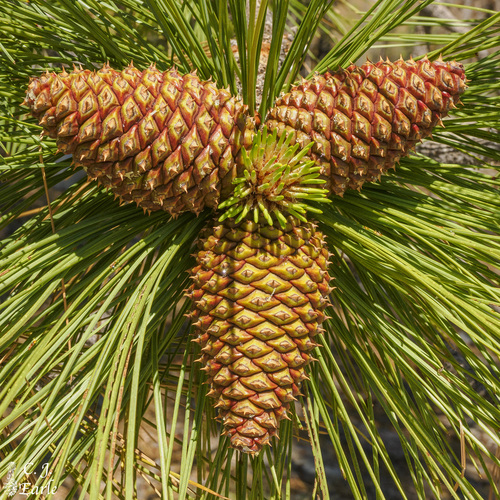
Pinus jeffreyi
Jeffrey pine · also Jeffrey's pine, Yellow pine, Black pine
Report an issue with this species
Pinus jeffreyi is a three-needle pine often dominating montane forests in California and Oregon, notable for its duller green needles, larger cones with recurved prickles, and bark emitting a sweet vanilla-butterscotch scent. It is highly tolerant of extreme, dry conditions and serpentine soils, making it suitable for challenging urban planting sites. This tree offers wildlife value by attracting birds and squirrels.
Where it grows
Trees in each city's inventory, with the share of that city's named trees this species accounts for.
- 200.00%36 yr18 in
- 190.01%—3.0 in
- 140.01%—21 in
- 30.01%—13 in
- 20.00%—48 in
- 10.00%—18 in
- 10.00%—14 in
- 10.01%—22 in
Traits
- Form
- Conifer
- Foliage
- Evergreen
- Mature height
- 50–100 ft
- Canopy spread
- 20–30 ft
- Growth rate
- Fast
- Sun
- Full sun
- Soil
- Well-drained
- Water needs
- Low
- Drought tolerance
- High
- Wildlife value
- Moderate
- Blooms
- Mar, Apr, May
Trunk diameters across every city: median 15 in, mean 16 in, 90th percentile 30 in. Measured at breast height, as published by each inventory.
Native range
Terrestrial ecoregions where this species is native. Trees in the dataset mostly stand well outside it.
Temperate Conifer Forests
- Klamath-Siskiyou forests
- Northern California coastal forests
- Sierra Nevada forests
Mediterranean Forests, Woodlands & Scrub
- California montane chaparral and woodlands
Other Pinus in the catalogue
51 of the top 2,000 species are in this genus.


