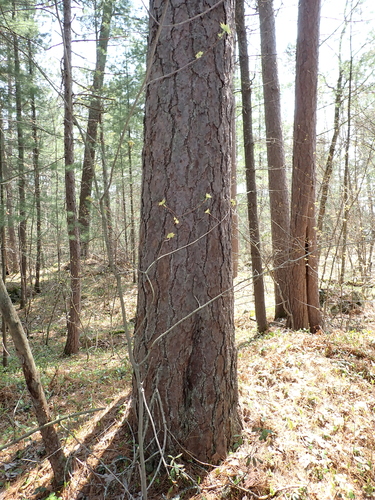
Pinus resinosa
Red pine · also Norway pine, American red pine, Canadian red pine
Report an issue with this species
Pinus resinosa, also known as red pine or Norway pine, is a conifer native to Eastern North America, ranging from the Great Lakes region to Manitoba and Newfoundland. It is an adaptable and valuable forestry species, characterized by low genetic diversity within its population.
Where it grows
Trees in each city's inventory, with the share of that city's named trees this species accounts for.
- 2,6700.82%—11 in
- 8351.1%—15 in
- 4880.15%8.9 yr9.1 in
- 4090.92%—12 in
- 3620.05%—12 in
- 3230.28%—15 in
- 2530.16%16 yr11 in
- 1561.3%—11 in
- 1490.02%—10 in
- 1310.16%—12 in
- 1110.04%—9.8 in
- 790.68%—12 in
- 320.07%—3.9 in
- 230.01%—7.5 in
- 160.01%—9.0 in
- 50.01%—14 in
- 30.00%—8.3 in
- 20.01%—15 in
Traits
- Form
- Conifer
- Foliage
- Evergreen
Trunk diameters across every city: median 12 in, mean 12 in, 90th percentile 17 in. Measured at breast height, as published by each inventory.
Native range
Terrestrial ecoregions where this species is native. Trees in the dataset mostly stand well outside it.
Temperate Broadleaf & Mixed Forests
- Eastern Canadian Forest-Boreal transition
- Eastern Great Lakes lowland forests
- New England-Acadian forests
- Southern Great Lakes forests
- Western Great Lakes forests
Other Pinus in the catalogue
51 of the top 2,000 species are in this genus.


