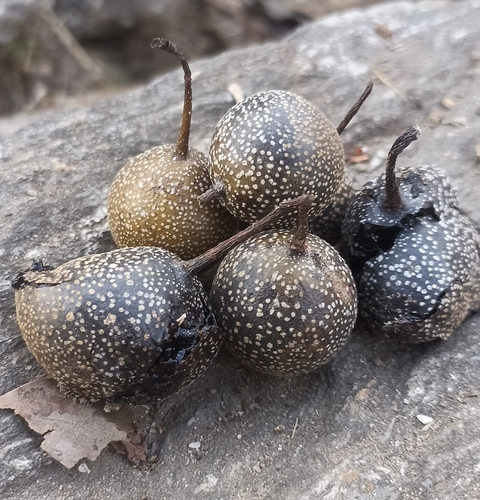
Pyrus pashia
Report an issueBy recorded trees in the inventory.
Wild Himalayan pear · also Himalayan pear, Wild pear, Afghan pear
Pyrus pashia, commonly known as the wild Himalayan pear, is a small to medium-sized deciduous tree. It features an oval crown, ovate leaves, and attractive white flowers with red anthers, producing small pear-like fruits. Native to southern Asia, it is a fruit-bearing species.
Traits
- Form & size
- FormBroadleaf
- Deciduous foliage
Trunk diameters across every city: median 1.5 in, mean 1.5 in, 90th percentile 2.1 in. Measured at breast height, as published by each inventory.
Where it grows
Cities that list the tree in their inventory, and what % of their named trees it represents.
- 570.24%——
- 10.00%—2.3 in
- 10.00%—0.8 in
- 10.00%——
No city in this list records planting dates for this species, so age is blank throughout.
Native range
Ecoregions where the species is native.
Tropical & Subtropical Moist Broadleaf Forests
- Northern Thailand-Laos moist deciduous forests
- South China-Vietnam subtropical evergreen forests
- Tenasserim-South Thailand semi-evergreen rain forests
Temperate Broadleaf & Mixed Forests
- Western Himalayan broadleaf forests
- Central China Loess Plateau mixed forests
Temperate Conifer Forests
- Western Himalayan subalpine conifer forests
- East Afghan montane conifer forests
Tropical & Subtropical Dry Broadleaf Forests
- Southern Vietnam lowland dry forests
Tropical & Subtropical Coniferous Forests
- Northeast India-Myanmar pine forests
Deserts & Xeric Shrublands
- South Iran Nubo-Sindian desert and semi-desert
Other Pyrus in the catalogue
17 of the top 2,000 species are in this genus.


