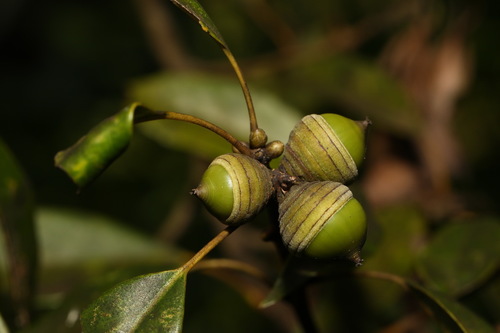
Quercus glauca
Ring-cupped oak · also Japanese blue oak, Ring cup oak
Report an issue with this species
Quercus glauca, also known as ring-cupped oak, is a widely distributed evergreen oak with a compact, rounded canopy and modest height. Its leathery, dark green leaves provide year-round shade, with young foliage emerging in bronze to burgundy tones. It thrives in warm, sunny locations with acidic soils but is not frost-hardy.
Where it grows
Trees in each city's inventory, with the share of that city's named trees this species accounts for.
- 3180.19%—6.3 in
- 1310.06%—5.5 in
- 70.00%—2.5 in
- 30.00%—11 in
- 10.00%—16 in
No city in this list records planting dates for this species, so age is blank throughout.
Traits
- Form
- Broadleaf
- Foliage
- Evergreen
- Mature height
- 25–40 ft
- Canopy spread
- 25–35 ft
- Growth rate
- Moderate
- Sun
- Full sun
- Soil
- Acidic
- Water needs
- Moderate
- Wildlife value
- High
- Blooms
- Mar, Apr, May
Trunk diameters across every city: median 6.0 in, mean 6.9 in, 90th percentile 12 in. Measured at breast height, as published by each inventory.
Native range
Terrestrial ecoregions where this species is native. Trees in the dataset mostly stand well outside it.
Tropical & Subtropical Moist Broadleaf Forests
- Nansei Islands subtropical evergreen forests
- South China-Vietnam subtropical evergreen forests
- South Taiwan monsoon rain forests
- Taiwan subtropical evergreen forests
Other Quercus in the catalogue
74 of the top 2,000 species are in this genus.


