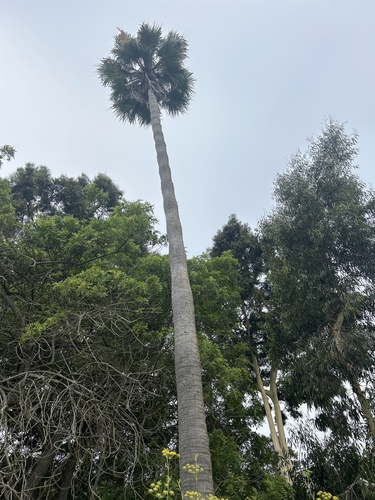
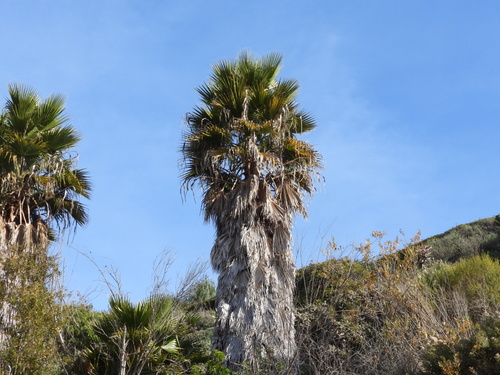
Washingtonia robusta
Report an issueBy recorded trees in the inventory.
Mexican fan palm · also Mexican washingtonia, Skyduster, Washington fan palm
The Mexican fan palm is a subtropical palm native to the Sonoran Desert. It is widely cultivated globally and is known to be the most common palm in Southern California, though it is considered a high-risk weed in Hawaii.
Traits
- Form & size
- FormPalmMature height50–70 ftCanopy spread10–20 ft
- Evergreen foliage
- Lifespan
- 500 years
- Fast growth rate
- USDA zones
- 8–11
- Sun
- Full sun
- Soil
- Well-drained, Clay-tolerant, Sandy, Alkaline
- Low water needs
- High drought tolerance
- Moderate wildlife value
- High fire risk
Size sketches use the middle of each recorded range (or the available bound), beside a 6 ft person. Missing dimensions are illustrative.
Trunk diameters across every city: median 14 in, mean 15 in, 90th percentile 21 in. Measured at breast height, as published by each inventory.
Where it grows
Cities that list the tree in their inventory, and what % of their named trees it represents.
- 29,9647.3%—21 in
- 1,2554.8%—13 in
- 9260.58%—15 in
- 6580.63%—14 in
- 3230.11%27 yr16 in
- 2211.3%——
- 1950.11%—15 in
- 1020.35%—12 in
- 870.03%—11 in
- 300.05%——
- 180.03%—14 in
- 140.01%—7.5 in
- 50.01%—30 in
- 10.00%—5.0 in
- 10.01%—8.7 in
Native range
Ecoregions where the species is native.
Deserts & Xeric Shrublands
- Sonoran desert
Other Washingtonia in the catalogue
3 of the top 2,000 species are in this genus.

